When I was a kid we didn’t have summer camp or timeshares or ocean cruises. We had Sycamore. That was where my paternal grandparents lived when I was young. Their homeplace was located in the remote woods of Clay County, in central West Virginia. Even by West Virginia standards, most of Clay County is remote. My grandma and grandpa lived in some of the “remotest.” It was almost an hour by car to the nearest town and a decent ride from their place to get back to a two lane road. When you were there, though, everyday things actually seemed further away than that. It was its own corner of the world and once you were in its grasp, it refused to share you with any other spots. Sycamore, however, was more than enough. It so occupied your time and thinking and senses as a child that there was no room for thoughts of what you may do back home or at school or at a friend’s house. It was a wonderful getaway, never dull and a great place to be a kid. It still holds a very special place in my memory and in my heart.
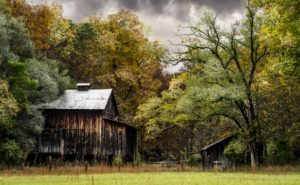
Just your typical downtown Saturday night in rural West Virginia.
To me, Sycamore was cricks, not creeks. It was dirt bikes and snakes and paths and fishing poles and hooks and bread and sand and cousins, always lots of cousins. It was where we went most weekends to meet up with family and enjoy the outdoors. But it was also Christmastime and cricks frozen solid in winter, full of crawdads, minnows and lizards in summer. It was dew so thick in the mornings and evenings that it would soak your shoes completely through. It was the powerful and stifling woodburning stove in the house. During cold weather, the living room and kitchen were kept at approximately 7,000 degrees fahrenheit by the stove, while the adjoining bedrooms were 15 below zero. Sometimes a smaller, sweatier cousin would freeze solid, right to the floor during a quick trip to the bathroom.
Sycamore was grandpa; his whistling and smoking. His recliner on the front porch. It was the white V-neck t-shirts and Dickies work pants he wore almost all the time and the way the package of L&Ms used to stick up out of his breast pocket like the crest on a blazer; bright reds and blues contrasted against the white background of the shirt. It was waking up to the sound of his drinking coffee from the bottom of a white styrofoam cup. His rhythmic slurping was our alarm clock.
It was also affectionately known as “down the crick,” as in, “Hey, we’re going down the crick. Wanna come?” This was because you had to cross the same meandering, persistent stream of water three times before you arrived at grandma and grandpa’s place. The crick continued to twist down the hollow until it poured out into the Elk River about seven miles away. I have crossed the waters of that crick at so many crossings on so many vehicles over the years. I have forded that stream on dirt bikes and four wheelers, in pickup trucks, side-by-sides, on foot and, as a young boy, in my dad’s old Ford Pinto. The Pinto was perhaps the most exciting because when the cricks were “up” high enough it would take on water through the cracks in the car doors. I’m not talking about a little leak or a trickle. I’m talking about a flow so strong that even as a 7 or 8 year old kid the thought of “abandoning ship” occasionally crossed my mind. I can still hear my dad, as we descended the bank to the first crossing, announce to my younger brother and I, “Okay, feet up!” Then the water would roll into the black-carpeted back floor of the car. Matthew and I would be sitting cross-legged in the seats watching gum wrappers and other debris bob around with our GI Joe men in the swirling pools below. Looking back on it now, I’m amazed at how commonplace that all seemed to me. A car taking on water like that. I suppose I should be equally amazed we all survived for years riding around in a Ford Pinto.
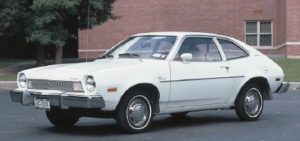
Ahh, the majestic beauty of the Ford Pinto. Exploding rear gas tank included!
As you meandered through the crick crossings and bounced down the rocky road, you would eventually come to Grandpa and Grandma’s gate, which was always open. There, the dense trees opened into a rectangular grass field that was around the width of a football field, but at least two or three times longer. The field was surrounded on all but one side by the tall, tree-covered mountains that West Virginia is known for. On the fourth side, several tall Sycamore trees stood guard between the creek and a sandy car track that took you the length of the field to the crossing of another smaller creek and up past the faded grey plank garage to the house. There was another small field adjacent to the house and a front yard area beneath a canopy of trees. The front yard seemed to stay lush and green and shaded almost all year round.
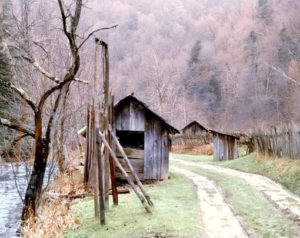
There’s not a whole lot of “urban sprawl” in West Virginia. Generally speaking, we like it that way.
From there you were open to any number of activities to fill up a fall Saturday or long summer’s week. Motorcycles, bikes, hiking (or what we called walking around in the woods), hunting, fishing, gardening, an early form of parkour (or jumping off stuff), exploring and a dozen other things awaited you on a typical day “down Sycamore.” The best part about it was that there always seemed to be someone else to do things with. Rarely were you alone on your little adventures. There was an almost endless supply of siblings and cousins to join you in passing the time. At one point there were 19 first cousins in the family somewhere between the ages of 4 and 24. That number does not include more distant relations such as second cousins, great uncles or not so great uncles. It was indeed a family roster deep in potential partners in crime.
One rather interesting incident occurred when I was 9 or 10. My brother Matthew and I were spending a summer week with Grandpa down the crick. About midweek we were joined by my second cousin Heath who was a year younger than me and a year older than Matthew. Heath’s father Nolan had also come along. The three of us boys spent the days running, stomping and jumping around Grandpa’s place trying to find new and exciting ways to injure ourselves. This, I’ve observed, is the typical pastime of boys ages 6-14. (My wife would say “boys ages 6 through forever” but I rarely, if ever, listen to her.) Grandpa and Nolan spent their time in pursuit of more adult pastimes: tinkering with the tractor, trying to start the tractor, sitting on the front porch talking about why the tractor wouldn’t start, tinkering with the tractor again. Yes, the days could be very demanding down the crick.
At one point in between the running and stomping, Heath pulled my brother and I aside.
“Hey, you guys wanna do something fun?” he said, with a slightly devious smile.
Matthew and I glanced at each other with confused looks on our faces.
“Jumping?” we said simultaneously. Heath just shook his head and motioned for us to follow him. Whatever his idea, it had to be something really fun.
We followed Heath down to Grandpa’s old garage. The garage didn’t look like much from the outside, but it stored a treasure of items for both work and play. Cables, ropes and hoses were organized and hanging from hooks on the walls. Rakes, shovels and hoes were leaned together in the corners. Yes, from welders to log splitters, motorcycles to gokarts, this garage had it all. Not all of it worked or would run for more than a few minutes at a time, but that was part of the fun.
The three of us crossed the threshold into the shade of the garage where we were met with the smell of grease and musty dirt. Just inside the door Grandpa kept several gas cans filled to varying levels with fuel. Gasoline was like gold here and was to be cherished and conserved. After all, the nearest gas station was almost an hour away. There were some nicer metal and plastic gas cans mixed in with a few old milk jugs, all used for holding this precious commodity. Heath selected one of the old milk jugs with just a tiny bit of gas left in it and out of the garage we went.

When you lived that far away from a gas station, one of these was worth more than we were.
These were the days before we had pollution or an environment to conserve, so a lot of people just kept old rusty oil drums or trash barrels outside and would burn extra cardboard or other trash instead of bagging it all up. Grandpa had just such a barrel outside of his garage near an old chicken coop. That seemed to be where Heath was heading. Matthew and I both shrugged our shoulders and headed off behind him.
The drum was spewing a little smoke and what trash was left inside was doing its best to reach the “smoldering” level. Heath twisted the lid off the old milk jug and poured the last trickle of gasoline in the barrel. Immediately the flame burst to life and rose up to the level just above the rim of the container. It quickly descended back inside near the level of the remaining trash..
“C’mon Heath,” Matthew said, “we’ve seen that before.”
I shared a somewhat let down glance with my brother and we both turned back toward our cousin. Sensing our disappointment, Heath now moved on to the real show.
“That wasn’t it” he said, his hands raising the now “empty” milk jug toward the top of the drum. He turned the jug upside down and held the opening as close to the fire as he could for about 5 seconds. He then set the milk jug down on the ground laying on its side, smiling all the while.
“Now, watch this!” he said. Matthew and I bent over slightly toward the jug as Heath jumped into the air and with both feet stomped the milk jug flat. At least I assume it went flat. I couldn’t really see much of anything after the first second or two because my eyelashes were suddenly engulfed in flames. It’s hard to pick out small objects when you’re trying to put out the aforementioned flames by blinking your eyes that fast.
Looking back on it, we really should’ve had a better idea what to expect. At the time, though, we just thought something exciting was going to happen to the milk jug…or maybe to Heath. Whether he did it on purpose or it was just a result of dumb luck, Heath had pointed the opening of the milk jug directly at us. (I have my own theories about this.) When his feet hit the jug the force caused a giant fireball to spew out of the container and head straight for us. As I said, I didn’t have much time to look, but it seemed to me to be about as wide across as a beachball and growing by the nanosecond. The flames washed over us in an instant and were gone just a quickly. Unfortunately, our small minds had processed the incoming threat, but they weren’t so quick to give the “all clear.” To put out the now dispersed flames, Matthew and I elected to skip over the “stop, drop and roll” technique and go directly to the “scream, jump in place and slap yourself silly” method. This method works almost as well as the original, but I wouldn’t recommend it if you’re in the company of anyone outside of close family. Even then I would suggest using it only around people who are healthy enough not to hurt themselves laughing really, really hard.
I’m not sure whether it was the screaming or the jumping or the giant fireball that alerted them to our activities, but we were soon joined by Grandpa and Nolan at the scene. After the details were sorted out: the gas, the gas can, the fireball, the scorching of our skin, we moved on to the punishment phase. Nolan didn’t say much, he just set about pacing behind Grandpa and seething. The three of us lined up facing the two angry men and waited. This was only one of a couple times that I saw my Grandpa get mad. It wasn’t pretty.
“What in the name…! I don’t know which of you is dumber! Who’s frizin’ idea was this?!” Frizin’ (pronounced FRY-zen) was my Grandpa’s form of swearing. I never heard him actually swear. I assume this was his own little form of “self censorship” employed around us grandkids.
“But…” all three of us said in unison.
“I don’t wanna hear it! I spend my hard earned money on a gas can and you fellas just go and burn it up! What am I gonna do for keeping my gas now?!” He looked at us. We looked at each other slightly confused.
“But…” Heath tried to interject.
“Aw, be quiet Heath!” uncle Nolan said.
“But dad! We didn’t burn up one of his good gas cans, it was just a milk jug!”
That revelation seemed to lighten the mood significantly. Grandpa no longer seemed like he was going to take the money for another gas can out of our hides. For his part, Uncle Nolan said nothing. He just rolled his eyes and started back to the house, presumably to think some more on how to get the tractor started.
Not wanting to let us completely off the hook, Grandpa left us with one last piece of advice.
“Will you boys please, pleeaaaseee act like you got some sense?!”
The three of us nodded quickly without saying a word. Grandpa started back to the house shaking his head. Heath stood there grinning that same devious grin. Matthew and I rubbed the bare patches where our eyebrows used to be. They say you never forget the smell of burnt hair. I agree. Especially if that hair is your own. I’m happy to report that my eyebrows did in fact grow completely back just in time for my senior prom.

The roaring waters of the mighty Elk River. Please feel free to insert your best banjo music/Deliverance joke here, because yeah, we’ve never heard that before.
In years that followed, my Grandma would pass on and my Grandpa would sell his property and move out of Sycamore. He settled in closer to one of my aunts and closer to civilization in general. Grandpa would pass away a few years after the move and, for a while, Sycamore became a very small part of my life. I grew up, graduated high school and college and eventually moved away from Clay County myself. My parents were (and are) still there, so I would visit them often, especially once I had kids of my own. Two of my uncles have property near where my Grandpa lived and we still meet up with family a good deal. Every once in a great while something will remind me of those glory days of my youth and a smile will cross my lips.
My siblings and I have also been able to purchase an old church camp near where we all live. Such was our fondness for Sycamore that we are endeavoring to turn this camp into a “Sycamore Part II” of sorts, for our children. (This generation of cousins now numbers at 10.) It does indeed remind me of Sycamore. It has rocky rough roads, we ride motorcycles and side by sides and it even has a little crick running through the property. The memories do come back thick and fast.
Occasionally, though, I may try too hard to bring back the memories. The last weekend at the camp, my wife chastised me severely when she found me sharing an old trick with my daughters and some of their cousins. I thought she overreacted. I mean it was just a milk jug with a trickle of gas inside. It wasn’t like it was the good gas can. Besides, kids don’t need eyebrows in elementary school anyway.